
Mill Lake: the Abbotsford mill pond that became the city's front yard
Short answer: Mill Lake is a small lake in central Abbotsford and the centrepiece of Mill Lake Park. First known to the Sto:lo Nation as Lekw'ōquem, it later powered the Trethewey brothers' sawmill, once among BC's biggest employers, before becoming a park in the 1930s.
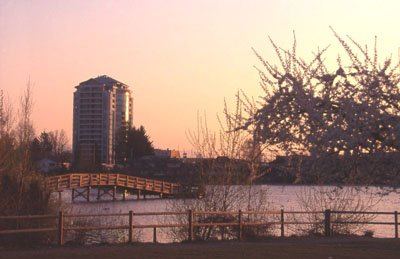
* Cover photo: Stevencool104, Wikimedia Commons, CC BY-SA 3.0
Every Fraser Valley city has a place that explains it, and in Abbotsford that place is Mill Lake. Today it is the calm centre of Mill Lake Park, ringed by a walking loop, playgrounds, and waterfowl. A century ago, it was an industrial pond sorting logs for one of the largest sawmill operations in British Columbia. The layers of that history are what make a visit worthwhile.
Lekw'ōquem
The lake's first known name is Lekw'ōquem, given by the Sto:lo Nation, who lived off the land and waters of the area for thousands of years before settlement. The lake sits between what are now the Trans-Canada Highway and South Fraser Way, in the heart of the modern city.
Settlers renamed it more than once: first Bais Lake, after an early farmer, then Abbotsford Lake, after its location. The name that stuck came from the industry that defined the town's early economy.
The mill that built Abbotsford
Around the turn of the twentieth century, Abbotsford resident Charles Hill-Tout opened a sawmill on the lake's shore, producing more than 50,000 railway ties for the Canadian Pacific Railway. In 1903, the Trethewey brothers, Joe, Richard Arthur, Sam, and Bill, bought the mill, and in 1912 they opened the Abbotsford Timber and Trading Company.
The company grew at astonishing speed into one of the highest employers in all of British Columbia, producing 20 million feet of timber boards a year. The lake itself worked as a mill pond: logs arrived by rail, were sorted in the water, processed, and shipped primarily to American markets. The boom ended in 1934, when the Great Depression and the depletion of local forests forced the brothers to close the site.
From mill pond to park
The Abbotsford Lions Club bought the mill site, removed the equipment, and began converting the shoreline into a park, bringing in sand and grass for visitors. That community effort created the Mill Lake Park Abbotsford knows today: the lake bordered by Bevan Avenue to the south, Ware Street to the east, Mill Lake Road and Bourquin Crescent to the north, and Emerson Street and Gladwin Road to the west.
The park now offers a paved loop trail around the water, boardwalks over marshy sections, playgrounds, picnic areas, an outdoor pool and water park in summer, and some of the best urban birdwatching in the valley. The lake's island and willow-fringed shores draw herons, ducks, and resident turtles, and community events use the park through the year.
Visiting from the Tri-Cities
Mill Lake is about 45 minutes from Coquitlam via Highway 1, a natural stop on any Abbotsford trip. The loop is flat, paved, and stroller-friendly, and the park's central location means coffee and lunch options are minutes away on South Fraser Way. Combine it with a stop at a Fraser Valley farm market in season for a full day out.
The park today
Modern Mill Lake Park is one of the Fraser Valley's best-equipped urban parks. Beyond the loop trail and boardwalks, it holds playgrounds, picnic shelters, sports fields, a spray park, and an outdoor pool complex that anchors Abbotsford summers. The lake's small island and marshy edges make it a genuine birding destination: great blue herons stalk the shallows, wood ducks nest in the trees, and the resident turtles bask on half-sunk logs within metres of joggers.
The park also carries the city's public memory. Community events, festivals, and charity runs use the grounds through the year, and the park's mature willows and open lawns give central Abbotsford a gathering place in a city that has grown at extraordinary speed around it.
The Trethewey legacy
The Trethewey brothers did not disappear with their mill. The family name remains woven into Abbotsford life, most visibly at Trethewey House, the brothers' restored 1920s heritage home near the lake, now a museum and cultural site run by the MSA Museum Society. Seeing the house and then walking the lake loop gives a visitor the full arc: the fortune the forest made, the mill the lake served, and the park the community chose to build in its place.
A city grown around its lake
Abbotsford's growth over the past generation has been among the fastest in Canada, and Mill Lake Park has become even more central as the city has densified around it. New residents in the towers rising along South Fraser Way treat the loop as their morning run; older residents remember when the mill whistle set the town's schedule. The lake holds both Abbotsfords at once, which is exactly what a city park is supposed to do. A master plan process continues to shape the park's future, with the city consulting on upgrades to trails, habitat, and amenities.
* Cover photo: Stevencool104, Wikimedia Commons, CC BY-SA 3.0
FAQ
Can you swim in Mill Lake?
No, the lake itself is for wildlife and viewing. The park's outdoor pool and water park, open in summer, handle swimming.
Why is it called Mill Lake?
The name comes from the sawmill that operated on its shore from the early 1900s to 1934. The Trethewey brothers' Abbotsford Timber and Trading Company was once one of the largest employers in BC, and the lake served as its log-sorting pond.
How long is the walk around Mill Lake?
The paved loop around the lake is about two kilometres, flat and accessible, with boardwalks, benches, and viewpoints along the way.
Sources
Follow Tri-Cities Daily
Daily local news, events and guides on Instagram: @tricitiesdaily
Related stories
Queen's Park: New Westminster's 1887 original, BC's first park
Queen's Park opened in 1887 for Queen Victoria's golden jubilee and was BC's first public park. Its arena, petting farm, trails, and 135 years of stories.
Campbell Valley Regional Park: Langley's 29 km of trails and history
Campbell Valley Regional Park packs 29 km of trails, a historic farmstead, a schoolhouse, and even an old NASCAR oval into south Langley's largest park.
Alouette Lake guide: Maple Ridge's mountain reservoir
Alouette Lake stretches 16 km beneath the Golden Ears, was renamed in 1914, and hides a dam-and-tunnel power story. Beaches, paddling, and history.