
Ioco: the company town Imperial Oil built on Port Moody's shore
Short answer: Ioco is a heritage townsite in Port Moody built by the Imperial Oil Company beside its 1914 refinery. Between 1920 and 1924, 83 houses went up, along with stores, churches and a community hall. The refinery closed in 1995; the townsite became a Heritage Conservation Area in 2002.
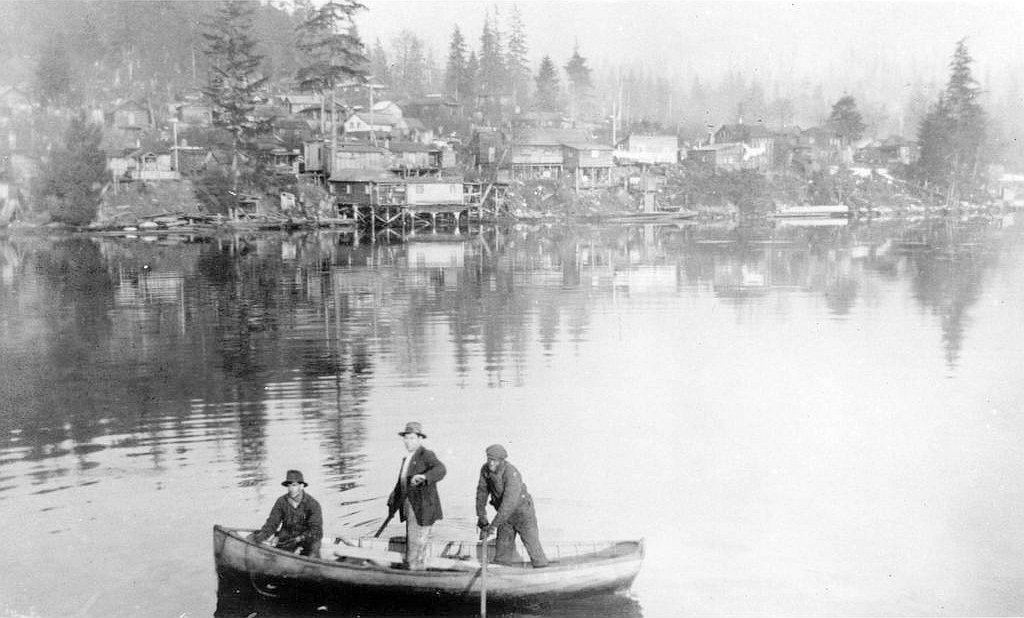
* Cover photo: unknown author, Wikimedia Commons, public domain
Drive Ioco Road along the inlet side of Port Moody and you pass through one of British Columbia's most complete company towns. Ioco, named for the Imperial Oil Company, was built to house the workers of the refinery next door, and a century later its small houses, church and general store still line the streets the company laid out.
The refinery comes first
The Imperial Oil Company, formed in London, Ontario in 1880, arrived in Port Moody in January 1914, when it purchased just over 83 acres on the north shore of the inlet. Site clearing for the Ioco oil refinery began that March, and the refinery was completed by December. Housing followed immediately: boarding houses for bachelors and sixteen houses for employees with families went up on the refinery property, and the original Ioco school was built in 1915.
The early settlement was rough. By 1917 the Ioco "shantytown" held about 200 people, with two grocery stores, a school and a post office. By 1919 the population passed 500, including 120 children. That year the workers formed the Ioco Housing Committee to press for a proper townsite, and a fall report to Premier John Oliver warned that most of the settlement's housing was far below standard.
Building the townsite
The answer was a planned community. In 1920 a co-operative society called the Ioco Townsite Company was incorporated with a capitalization of $100,000, governed by a "town council" of six men named by the employees. The company bought 22 more acres east of the refinery, surveying began, and in December 1920 the townsite subdivision plan was registered.
Construction moved fast. The first houses were the sixteen employee cottages relocated from the refinery property, followed by 43 Craftsman-style houses. Between 1920 and 1924, 83 houses were built. The amenities came just as quickly: the road from Port Moody was completed and a public dock built at the foot of First Avenue in 1921, the same year the Ioco Community Hall went up and the Ioco baseball team captured the provincial amateur championship. The Ioco Grocery Store and the lawn bowling green and clubhouse followed in 1922, St. Andrews United Church in 1923, the Ioco Presbyterian Church, built by volunteer labour at Ioco Road and First Avenue, in 1924, and All Saints Anglican Church on First Avenue in 1926.
Town life, company style
Life in the young townsite had a rhythm all its own. The Ioco Townsite Company ran the community's affairs through its employee-named council, a hybrid of company town and co-operative that was unusual for its era. Baseball mattered enough that the 1921 provincial championship is still part of local lore. The lawn bowlers got their green in 1922, and the churches, United, Presbyterian and Anglican, anchored the weekends. When the B.C. Telephone Company laid submarine cables across the Port Moody Arm in the 1920s, the townsite joined the region's phone network by water, the same way its oil arrived.
The townsite even tried for independence: in September 1922 the Ioco Townsite Company made a bid to incorporate as a municipality. It stayed part of the region instead, but the attempt says much about how real, and how proud, this little community was.
Boom years and decline
The refinery grew with the town. By 1928 it reached a throughput of 10,000 barrels a day. The Trans Mountain Pipeline connected to Ioco in 1953, and the refinery was re-equipped into the most modern in Canada and the largest in the Pacific Northwest. The community around it lived the classic company-town life: the hall, the churches, the store, the bowling green, the school at the corner of Ioco Road and First Avenue.
The end came in 1995, when the last shipment of crude oil reached the refinery through the Trans Mountain Pipeline and Imperial Oil ceased operations at Ioco. The industrial site was converted, and the townsite was left to decide what it would become.
Heritage saved it
What saved Ioco was recognition of exactly what it was: a rare, intact company town. In 2002 the City of Port Moody designated the Ioco Townsite as a Heritage Conservation Area, and it was added to the Canadian Register of Historic Places the same year. The first Ioco Ghost Town Days celebration followed, later becoming the Ioco Festival under the Port Moody Heritage Society. Heritage Conservation Area Guidelines were adopted in 2012, and in 2019 Port Moody amended its Official Community Plan to limit future development of the Ioco lands.
Today the townsite is a quiet residential enclave with an outsized story. The Craftsman houses, the 1922 store, the churches and the green where the bowlers played remain a working archive of the years when the company built not just a refinery, but a whole town to run it.
FAQ
What does Ioco stand for?
Ioco is the Imperial Oil Company, which built the refinery in 1914 and the planned townsite beside it starting in 1920 to house its workers.
Is the Ioco refinery still operating?
No. The last crude shipment arrived in 1995 and the refinery closed that year. The townsite survives as a Heritage Conservation Area designated by Port Moody in 2002.
Can you visit Ioco?
Yes. The townsite is a residential neighbourhood on Ioco Road in Port Moody, listed on the Canadian Register of Historic Places, with heritage houses, the 1922 store and historic churches.
Sources
Follow Tri-Cities Daily
Daily local news, events and guides on Instagram: @tricitiesdaily
Related stories
Riverview Hospital: the story of Coquitlam's Essondale grounds
Riverview Hospital opened in 1913, once housed 4,725 patients, and shaped Coquitlam for a century. Its history, 2012 closure, and what stands there now.
POMO Museum: Port Moody's railway station that became a time capsule
The POMO Museum occupies Port Moody's second CPR train station, moved by truck in 1978. Inside: a 1921 sleeper car and a barrel of postcards.
Maillardville and Festival du Bois: Coquitlam's French heart
Maillardville was founded in 1909 by French Canadian mill workers recruited to Fraser Mills. Their legacy lives on in Festival du Bois each March.